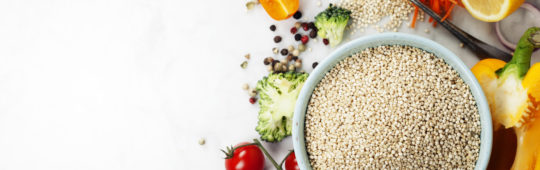
6 Health Benefits of Quinoa + Nutrition Profile
Touted as a superfood, quinoa is a darling of the health-conscious community. It’s credited with everything from preventing heart disease to curing world hunger, but how much of the hype is backed up by research? Take a closer look at the science of quinoa to find out.
What Is Quinoa?
Quinoa (Chenopodium quinoa) has been cultivated for thousands of years in the Andes Mountains of South America, where it is a food staple for indigenous cultures. It’s only in recent years that is has attracted global attention [1].
Climate change and increasing global food demand have created a need for crops that thrive in suboptimal growing conditions and provide quality nutrition. Quinoa, a stress-tolerant crop with a better nutritional profile than many kinds of cereal like rice and corn, has attracted attention for this reason. It’s now grown in more than 70 countries [2, 1].
Its potential to improve the health of undernourished people is supported by research. When 10 undernourished boys from poor Ecuadorian families between the ages of 4 and 5.5 years were fed a quinoa-based infant food twice a day for 15 days, growth hormone (somatomedin C) production increased compared to a control group [3].
Although it’s often referred to as a cereal, quinoa is actually a pseudocereal. Cereal grains like wheat, rice, and corn are grasses, and their nutritional value comes from the grass fruit. Quinoa is more closely related to spinach and chard and its nutritional value comes from the plant’s seed [1].
Although there are more than a hundred varieties of quinoa, only 3 are commonly available in grocery stores around the world: red, black, and white. It’s prepared like rice but, before boiling, all quinoa must first be soaked to remove the outer coating (pericarp), which contains bitter compounds (saponins) [4].
Components
Quinoa is rich in many important macronutrients, micronutrients, and other molecules (secondary metabolites) that can affect human health [1].
Although quinoa is more nutritious than most grains, it shows a lot of variability in its composition. The variety of quinoa and where it’s grown impact its nutritional profile. That means nutrients in the quinoa you eat may vary from the values reported here and elsewhere [5, 6].
Protein
Relative to most grains, quinoa has a high protein content (12.9 to 16.5% protein). It has more protein than rice, corn, oats, and barley, and about the same amount as wheat (14.3
